Most AI website builders promise you can create a website in minutes, but what does that timeline actually include? While AI can generate a professional-looking website surprisingly quickly, you’ll still need time to choose a domain, review the generated content, make a few edits, and publish your site. In this guide, we’ll break down the entire journey and share a realistic estimate.
Key takeaways
- AI website builders significantly reduce the time for initial website setup, but require additional time for edits and refinements
- Creating a basic website typically takes 30 to 90 minutes, depending on preparation, while AI can generate a first draft in about 3 minutes
- Key stages of website creation include defining purpose, selecting a domain, and adding content, each taking varying amounts of time
- Post-launch, focus on content updates, SEO improvements, and monitoring performance to maintain a strong online presence
- AI tools streamline the initial setup, but successful websites still require ongoing personalization and development to truly reflect the brand
A realistic timeline: How long each stage of website creation takes
Every website follows a similar journey before it goes live. Whether you’re creating a portfolio, a business website, or an online store, you’ll need to plan your website, register a domain, set up hosting, create pages, add content, and test everything before publishing.
The time required for each stage depends on your website’s complexity, the resources you already have, and how prepared you are before you begin. The table below provides a realistic estimate of how long each stage typically takes.
| Stage | What it involves | Typical time |
| Define your website’s purpose | Decide what your website should achieve, identify your target audience, and outline the pages and features you’ll need. The clearer your goals are, the easier the rest of the process becomes. | 30 minutes–1 day |
| Research your market (Recommended) |
Review similar websites to understand industry trends, gather inspiration, and identify opportunities to differentiate your website. | 1-3 days |
| Choose a domain name | Brainstorm a memorable domain name, check its availability, and register the one that best represents your brand. | 30 minutes–1 day |
| Set up web hosting | Choose a hosting provider, create your hosting account, and configure the essentials needed to make your website accessible online.
Tip: Bluehost Web Hosting includes reliable hosting, a free SSL certificate, domain management, and website management tools in one place, helping you get online without juggling multiple services. |
30 minutes–1 day |
| Create your website | Build your website’s structure by creating pages, organizing navigation, choosing layouts, and adding the functionality your visitors will use. | 1-7 days |
| Add your content | Write and review your page copy, upload images and videos, add contact information, and make sure every page accurately represents your brand. | 1-7 days |
| Review and test your website | Test your website on different devices, verify links and forms, check loading speed, review mobile responsiveness, and fix any issues before launch. | 2-8 hours |
| Publish your website | Connect your domain, perform final checks, and make your website publicly available for visitors. | 30 minutes–2 hours |
Additional factors that may extend your timeline
The timeline above reflects the steps involved in building a typical website. However, certain features and functionality can add additional time depending on your requirements. For instance, if you’re building an eCommerce website or a multilingual website, the following will be added to your timeline:
| Requirement | Additional time |
| Setting up an online store | 1-5 days |
| Adding products and categories | Several hours to multiple days |
| Configuring product variants (size, color, etc.) | A couple of hours to 2 days |
| Setting up payment gateways | 1-2 days |
| Configuring shipping and tax settings | 1-3 days |
| Configuring shipping and tax settings | 2-8 hours |
| Connecting third-party tools (CRM, email marketing, analytics, booking systems, etc.) | A couple of hours to 2 days |
| Creating multilingual pages | Several days to weeks |
Keep in mind that the estimates above focus solely on the website creation process. Some projects may require additional planning before you even begin building. For example, businesses entering a competitive market often spend extra time researching competitors, refining their brand positioning, defining their target audience, or planning their content strategy. While these activities can extend your overall timeline, they often result in a more focused website that better serves your visitors and supports your business goals.
How AI website builders have changed the website creation timeline
Traditionally, creating a website involves much more than writing content. Before you can even start customizing your site, you have to make a series of decisions that shape its overall structure and design.
The manual work AI helps you skip
Building a website from scratch typically involves tasks such as:
- rowsing and selecting a template
- Choosing colors and typography
- Deciding which pages to include
- Creating a navigation menu
- Arranging sections on each page
- Drafting placeholder content for your homepage and key pages
None of these tasks is particularly difficult on its own, but together they can easily add hours to the website creation process.
AI website builders shorten this setup phase by turning it into a guided onboarding experience. Instead of making every decision manually, you answer a few questions about your business, and the AI generates a website structure, page layouts, navigation, design elements, and draft content for you.
Rather than starting with a blank canvas, you start with a complete first draft that’s ready for review.
Putting AI website creation into practice
To see how this works in practice, I used the Bluehost AI Website Builder while building a website with AI from scratch.
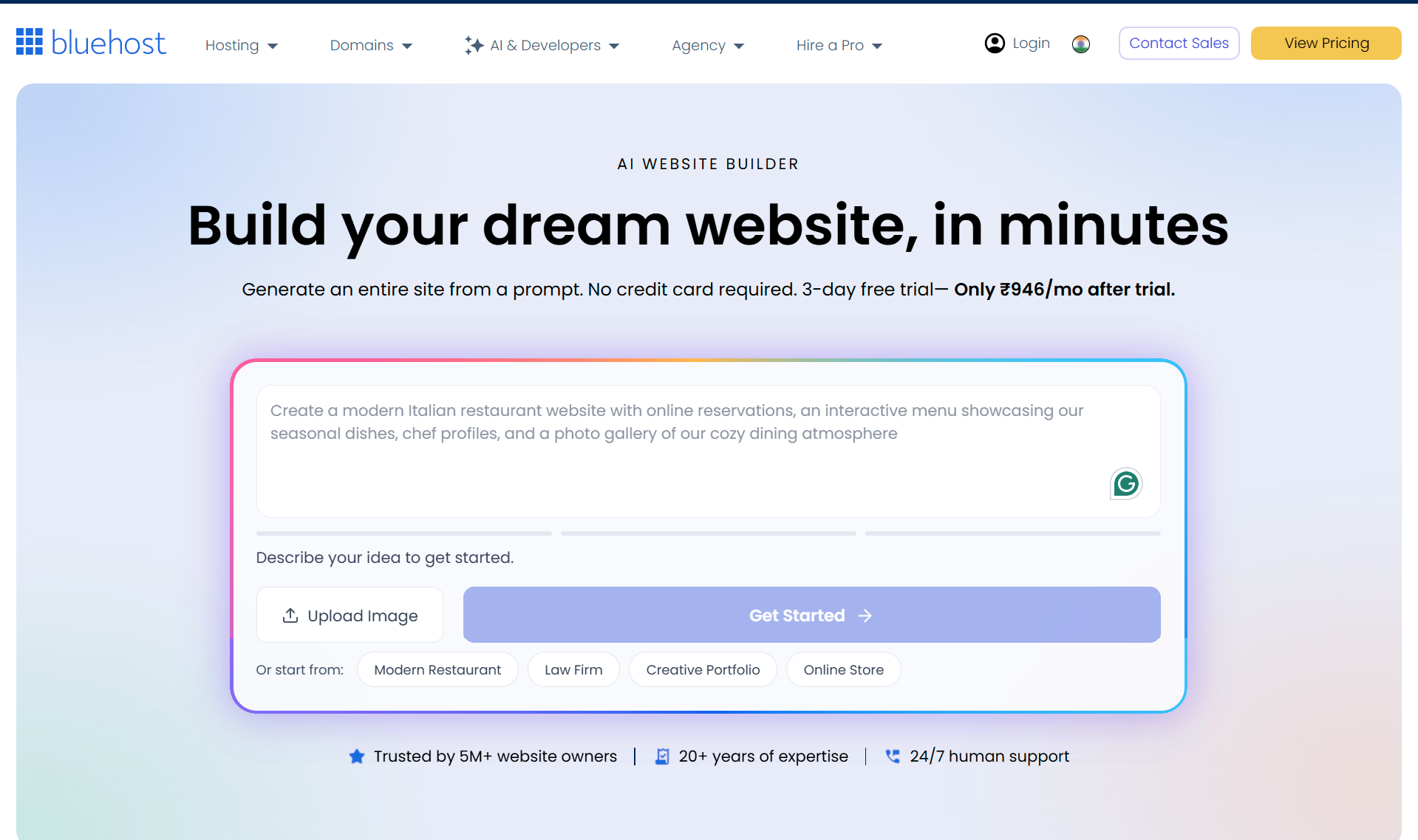
The process was straightforward:
- Describe the website in a single sentence
- Create an account and verify your email address
- Answer a few questions about your business, website goals, preferred design style, and overall tone
- Let the AI generate the website
Once onboarding was complete, the AI produced a complete first draft in about 3 minutes. The generated website already includes:
- A homepage
- A navigation menu
- Pre-designed page sections
- AI-generated copy
- Placeholder images based on the information provided
It’s still WordPress underneath
One feature that stood out was that the generated website wasn’t locked inside a simplified editor. Because Bluehost’s AI Website Builder is built on WordPress, I could immediately access the complete WordPress dashboard to:
- Edit pages
- Preview posts
- Install plugins
- Customize themes
- Manage site settings
In other words, the AI accelerated the initial website setup without limiting what I could do afterward.
Where you’ll probably spend the most time
Although AI significantly reduces the time required to create the first version of a website, there are still several areas where you’ll likely invest additional time.
Refining your content
AI-generated copy provides a strong starting point, but it should reflect your products, services, brand personality, and unique value proposition. Reviewing and personalizing the content is one of the most important steps before publishing.
Choosing the right images
The first draft may include placeholders or stock images. Replacing these with your own photography, product images, or branded visuals helps create a more authentic and trustworthy website.
Expanding your website
Depending on your business, you may want to create additional pages beyond the initial draft, such as an About page, service pages, FAQs, testimonials, pricing information, or a blog. AI accelerates the initial launch, but your website can continue to grow over time.
Optimizing for search engines
Publishing your website doesn’t mean your work is finished. Optimizing page titles, meta descriptions, internal links, headings, and on-page content, as well as creating valuable blog posts, is what helps people discover your website through search engines over the long term.
While AI can dramatically reduce the time it takes to create a website, the biggest improvements usually come after the first draft. Personalizing your content, using original visuals, expanding your website with valuable pages, and continuously improving your SEO are what transform an AI-generated starting point into a website that genuinely represents your brand and stands out from the competition.
Final verdict: So, how long does it really take to build a website with AI?
If you’re wondering whether AI website builders really save time, the answer is yes, but perhaps not in the way most marketing claims suggest.
The website generation itself is remarkably quick. In my experience, the Bluehost AI Website Builder produced a complete first draft in around three minutes after the onboarding process. However, creating an account, verifying your email, answering the AI’s questions, reviewing the generated website, and making your own edits naturally add to the overall timeline.
For most people starting from scratch, it’s reasonable to expect a basic website to be online within 30 to 90 minutes, depending on how prepared you are. If you already have your domain, branding, and content ready, you could realistically publish in under 15 minutes. On the other hand, if you’re building a more polished website with custom copy, additional pages, and SEO improvements, you should expect to spend a few hours or even a full day refining it.
The biggest impact of AI isn’t that it builds a perfect website in minutes. It’s that it compresses what used to be the most time-consuming part of website creation, setting up the structure, layouts, navigation, and first draft into a guided process that takes only a few minutes. Instead of spending hours building a website from an empty canvas, you can dedicate your time to improving the content, design, and user experience, which are ultimately the elements that make a website successful.
So, are AI-generated websites any good?
For most individuals and small businesses, yes, they’re a strong starting point. AI website builders can generate a professional-looking first draft in minutes, but you’ll still get the best results by personalizing the content, visuals, and SEO to reflect your brand and goals.
AI builds websites quickly, but growing one still takes time
Once your website is live, keeping it useful, discoverable, and up to date still requires ongoing effort. AI website builders can help you create and publish a website much faster than traditional methods, but launching your website is only the beginning.
Here are a few areas to focus on after launch.
Publish helpful content regularly
Whether you’re running a business website or an online store, regularly publishing helpful content keeps your website fresh and gives people more reasons to visit. If you’re not sure where to start, check out our guide on writing an SEO-friendly blog post.
Keep your website up to date
Your website should evolve alongside your business. As your products, services, pricing, or contact information change, make sure your website reflects those updates. You can also expand your website over time by adding new landing pages, service pages, FAQs, or case studies as your business grows.
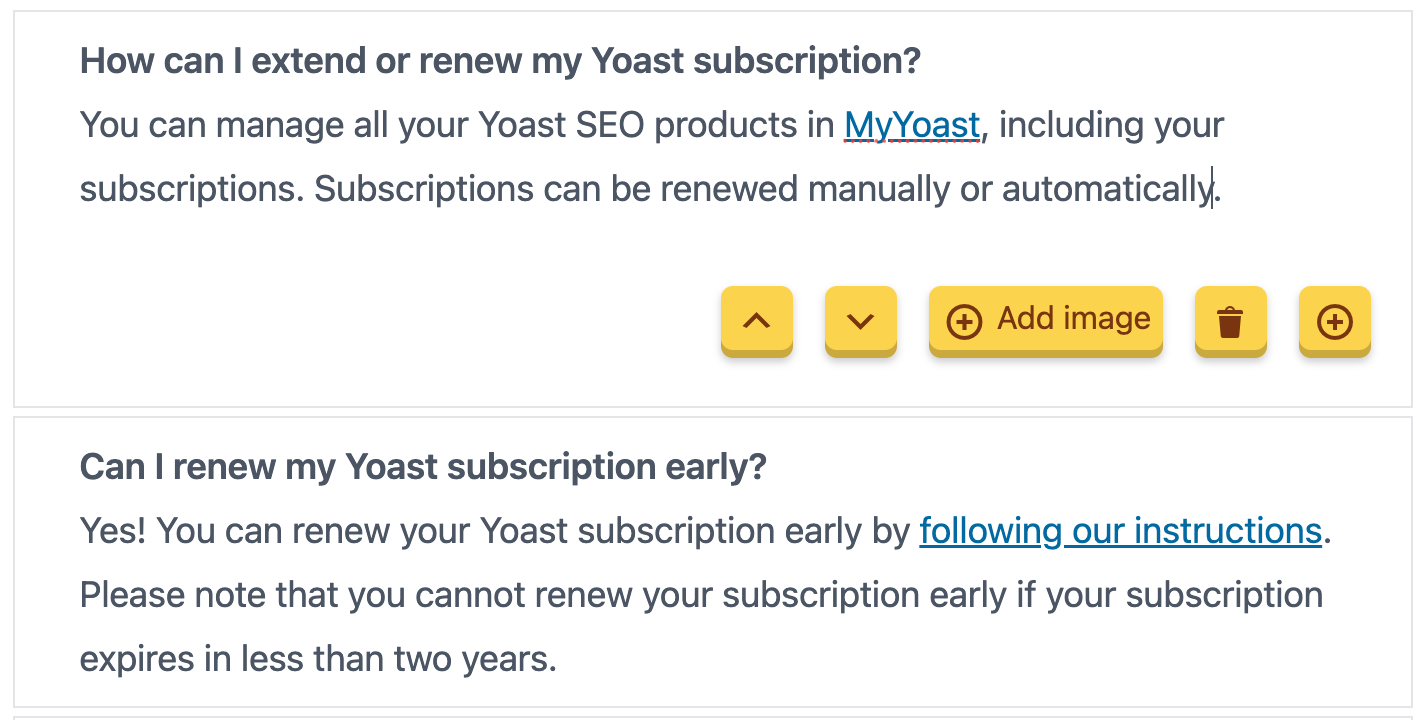
If you are using Yoast SEO, creating FAQ pages becomes very easy. The plugin’s FAQ content block converts your questions into structured data, making them easier for search engines and AI crawlers to digest.
A smarter analysis in Yoast SEO Premium
Yoast SEO Premium has a smart content analysis that helps you take your content to the next level!
Continue improving your SEO
Publishing your website is only the first step. To help people find your website, you’ll need to continue optimizing both your content and your website’s technical foundation.
That includes creating helpful content around the topics your audience is searching for, improving internal linking, and regularly reviewing your pages to keep them accurate and relevant. It’s also worth checking that search engines can easily crawl and index your website, that your XML sitemap is up to date, that your pages load quickly, and that there are no broken links or indexing issues affecting your visibility.
If you’re using WordPress, our definitive guide to WordPress SEO covers both on-page and technical SEO best practices to help you build a strong foundation for long-term growth.
Monitor your website’s performance
Understanding how people discover and interact with your website helps you make better decisions.
Start by connecting your website to Google Search Console to monitor search performance, identify indexing issues, and see which queries drive traffic to your site. Pair it with Google Analytics to better understand user behavior and measure the impact of your SEO efforts over time.
Helpful resources:
- What is Google Search Console?
- How to add your website to Google Search Console
- Tracking SEO with Google Analytics
Build your AI presence
As AI-powered search experiences continue to evolve, it’s becoming increasingly important to understand how your brand is represented beyond traditional search results.
If you’re using Yoast SEO AI+, Yoast AI Brand Insights helps you understand how AI platforms perceive your brand and identify opportunities to strengthen your online presence as AI search continues to grow.
How much faster is building a website with AI?
AI website builders don’t eliminate every step of website creation, but they dramatically shorten the time it takes to go from an idea to a working website. Instead of spending hours manually setting up the foundation, you start with a complete first draft that you can immediately personalize.
Here’s how the experience typically compares.
| Traditional website creation | Building a website with AI |
| Days or weeks to create the initial website | A working first draft in minutes |
| Browse and compare templates manually | AI recommends a design based on your requirements |
| Build page layouts section by section | AI generates complete page layouts |
| Create navigation menus manually | Navigation is generated automatically |
| Write placeholder copy from scratch | AI creates an initial content draft |
| Start with a blank page | Start with a complete website structure |
| Spend time assembling the website | Spend time refining and personalizing it |
The biggest difference isn’t that AI removes the need to edit your website; it changes where your time is spent. Rather than investing hours creating the foundation, you can focus on improving the parts that have the greatest impact on your visitors, such as your messaging, branding, content, and SEO.
AI gives you a head start, not the finish line
Creating a website no longer has to be a weeks-long project. AI website builders have transformed what was once the most time-consuming part of the process, setting up layouts, pages, navigation, and initial content, into something that can be completed in minutes.
That doesn’t mean AI builds a perfect website on its own. A successful website still depends on thoughtful content, strong branding, regular updates, and ongoing SEO. What AI does provide is a significant head start, allowing you to skip the blank page and spend your time refining a website instead of building one from scratch.
If you’ve been putting off creating a website because it felt too technical or time-consuming, AI has made getting started easier than ever. The sooner you launch, the sooner you can begin growing your online presence.
The post How long does it really take to build a website with AI? appeared first on Yoast.
