Key takeaways
- Social media algorithm ranking signals: Algorithms use ranking signals like engagement, watch time, and relevance to decide which content each user sees, and every platform weighs these signals differently.
- Major platform differences in 2026: Instagram prioritizes watch time, likes, and sends; LinkedIn rewards content quality and early engagement; TikTok’s algorithm favors discovery from accounts users don’t follow; and Reddit relies on community voting.
- Best optimization strategies: Creating high-quality content consistently, engaging authentically with your community, and adapting to each platform’s preferred formats are the most reliable ways to earn algorithmic reach.
- AI’s growing role: AI plays a larger role in how algorithms filter, rank, and personalize content, making first-party engagement data more important than ever for marketers.
What are social media algorithms?
Social media algorithms are collections of rules, ranking signals, and calculations that decide the content priority and display order for each user. A social media algorithm is a collection of rules, ranking signals, and calculations that decide the content priority and display order for each user.
AI-powered social media algorithms determine what we see across the 141 minutes per day the average user spends on social media, using machine learning to constantly evolve and personalize the user experience.
Back in the early 2000s, when platforms like MySpace and Facebook first emerged, algorithms were purely chronological. Users saw content from people they followed (and later, brands) from most recent to oldest.
However, as social media gained popularity, complex algorithms started curating content based on user behavior and interests. Facebook’s News Feed, launched in 2006, was a pioneer — its underlying algorithm, later dubbed EdgeRank, was publicly detailed in 2010 and replaced in 2011 by more advanced algorithms.
And in 2026, every modern social platform ranks and displays content based on its own social media algorithms, except Bluesky, where chronological is the default. Some platforms, such as X, Facebook, and Instagram, also still offer a chronological option.
#1 Analytics Tool for Growth
Beautiful reports. Clear data. Actionable insights to help you grow faster.
How a social media algorithm works in practice
Here’s a simple example. Say you watch three cooking Reels to completion on Instagram. The algorithm notes your watch time, checks whether you’ve engaged with similar food content before, and starts surfacing more cooking Reels in your feed and Explore page.
Meanwhile, a friend who skips past cooking content and likes travel photos will see an entirely different set of recommendations. That’s personalization at work: the same platform, powered by the same algorithm, delivering a unique experience for every user.
Key social media algorithm terms
Ranking signal: An attribute or factor used by social media algorithms to assess content quality and relevance. Ranking signals influence the inclusion or exclusion of content in a user’s search results or feed, and display order.
Machine learning: A component of artificial intelligence systems that can make sense of data, react, learn from, and/or act on information without needing instructions from a human. Heavily reliant on pattern recognition.
Artificial intelligence (AI): Technology enabling computers to solve complex problems, mimic human reasoning, and automate tasks traditionally done by humans.
What ranking signals do social media algorithms use?
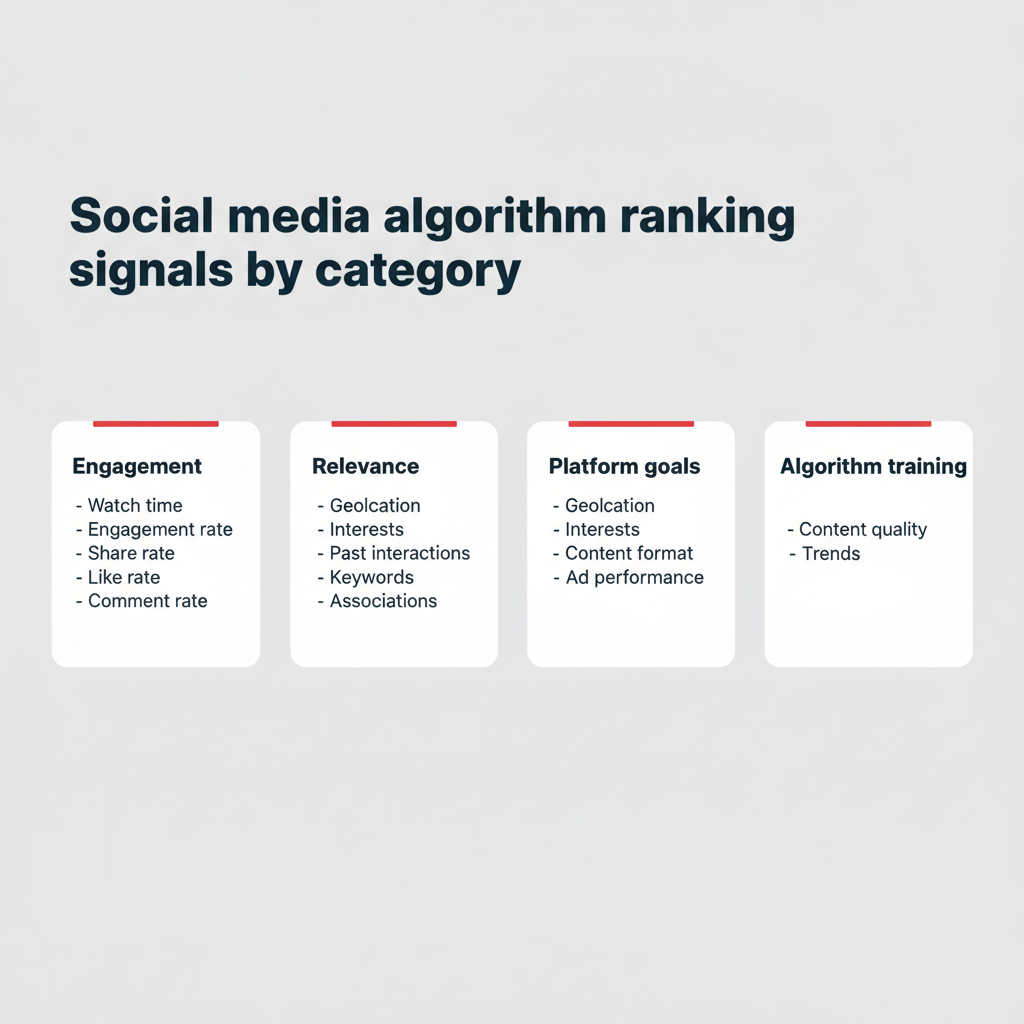
Social media algorithms use engagement metrics, relevance signals, and platform-specific priorities to rank content. Each platform personalizes user experience using its own set of social media algorithms, including ranking signals, machine learning models, and priorities. While the specifics vary, most algorithms draw from a common set of signal categories.
Here are the most common social media algorithm ranking signals in 2026.
Engagement-based ranking
- Watch time: Important for videos, but counts for photo or text content too.
- Engagement rate: The percentage of likes, comments, and shares vs. total views.
- Share rate: Number of shares vs. total views.
- Like rate: Number of likes vs. total views.
- Comment rate: More comments mean higher engagement rate but some algorithms, such as LinkedIn, also factor in discussion quality and sentiment.
Relevance and personalization
- Geolocation: Many social media platforms have location tagging features for enhanced local discovery, plus user account settings may influence content shown.
- Interests: Topics the user follows (such as hashtags on LinkedIn) as well as predictions based on recent activity.
- Previous interactions and behavior: Recent engagements (likes, comments, shares) plus the accounts a user follows help social algorithms make predictions.
- Keywords and/or hashtags: Help algorithms categorize content and match it with user interests.
- Associative relationships: How likely a user is to be interested in a piece of content or account based on similar followed accounts.
Platform goals
- Content format: Social media algorithms often prioritize newly launched formats and can change quickly to keep up with trends, like when Instagram prioritized Reels before switching to carousels.
- Ad performance: Ads are how social media platforms make money and algorithms are at the heart of ensuring they perform well.
Algorithm training
- Content quality: Subjective, based on user interests, but for algorithms it usually means if a post follows size requirements and policies.
- Trends: Algorithms learn to detect and amplify social media trends.
How do algorithms work on every major social network in 2026?
Each major social network uses distinct algorithms with different ranking priorities. Here’s a comparison of how the top platforms rank content in 2026.
|
Platform |
Top ranking signals |
Preferred format |
Chronological option? |
|---|---|---|---|
|
|
Watch time, likes, sends |
Reels, carousels |
Yes |
|
|
Predicted engagement, connections |
Video, photos |
Yes |
|
TikTok |
Watch time, user activity |
Short-form video |
No |
|
|
Content quality, early engagement |
Text, documents |
No |
|
YouTube |
Watch time, relevance |
Long and short video |
No |
|
X |
Connections, recency |
Text, images |
Yes (Following tab) |
|
Threads |
Predicted engagement, view time |
Text |
Yes (Following tab) |
|
|
Visual relevance, saves |
Images, Pins |
No |
|
Bluesky |
User-controlled, community |
Text |
Yes (default) |
|
|
Upvotes/downvotes, comment quality |
Text, images |
Yes (New sort) |
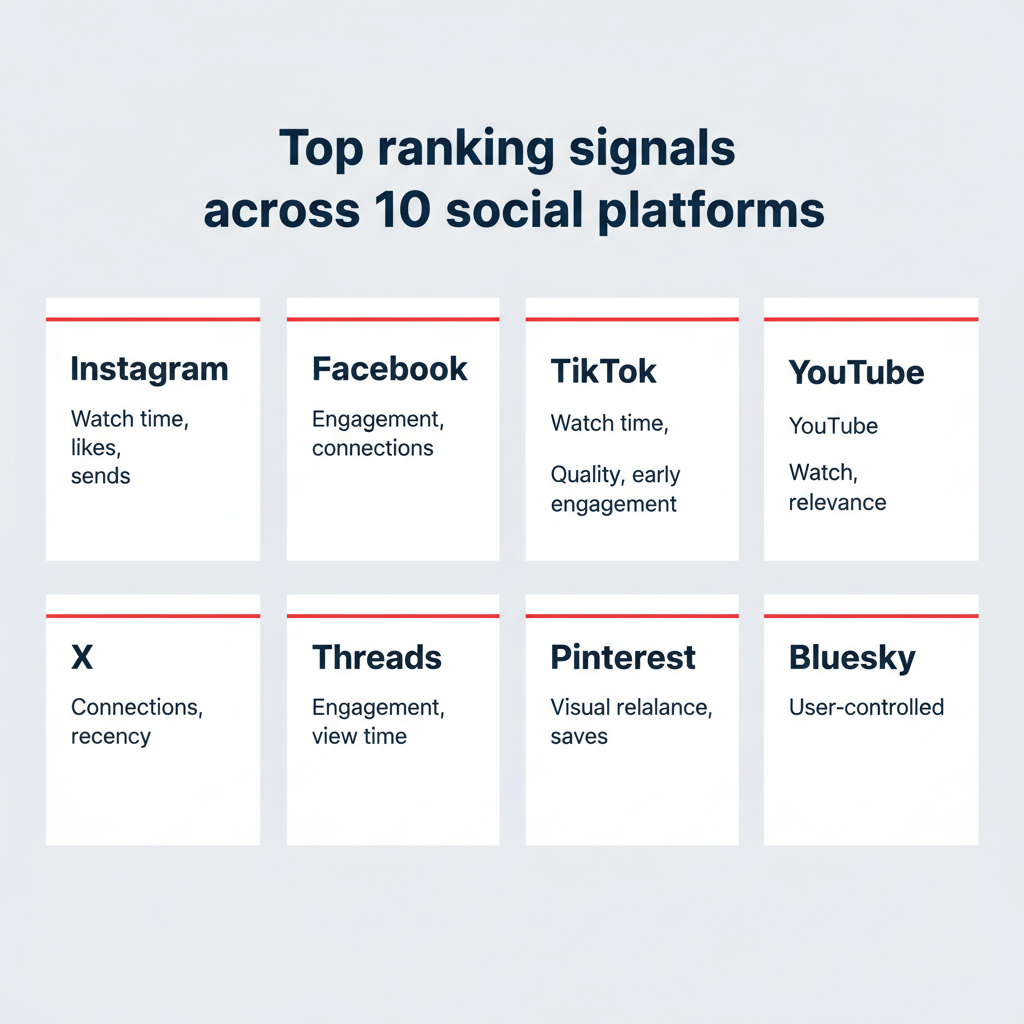
Overall, the top three ranking signals on Instagram in 2026 are watch time, likes, and sends, according to Head of Instagram, Adam Mosseri:
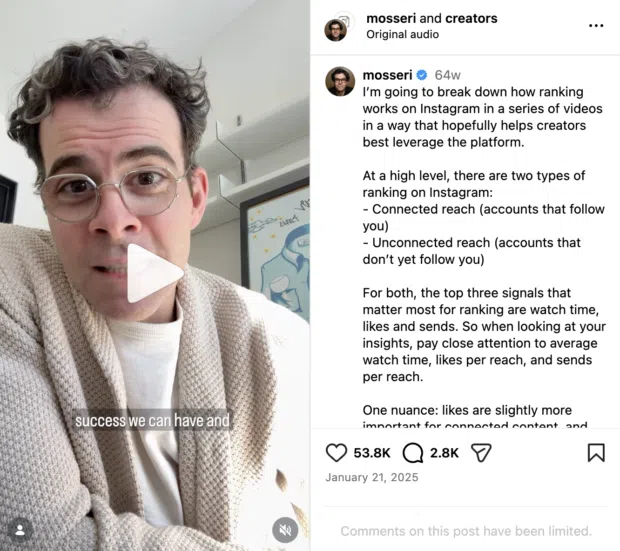
Source: @mosseri
Going a little deeper into how Instagram ranks content, there are two types:
- Connected reach (how you rank for people who follow you)
- Unconnected reach (how you rank for people who don’t follow you)
Each ranking type uses slightly different priorities: likes are more important for connected reach, while sends are more important for unconnected reach.
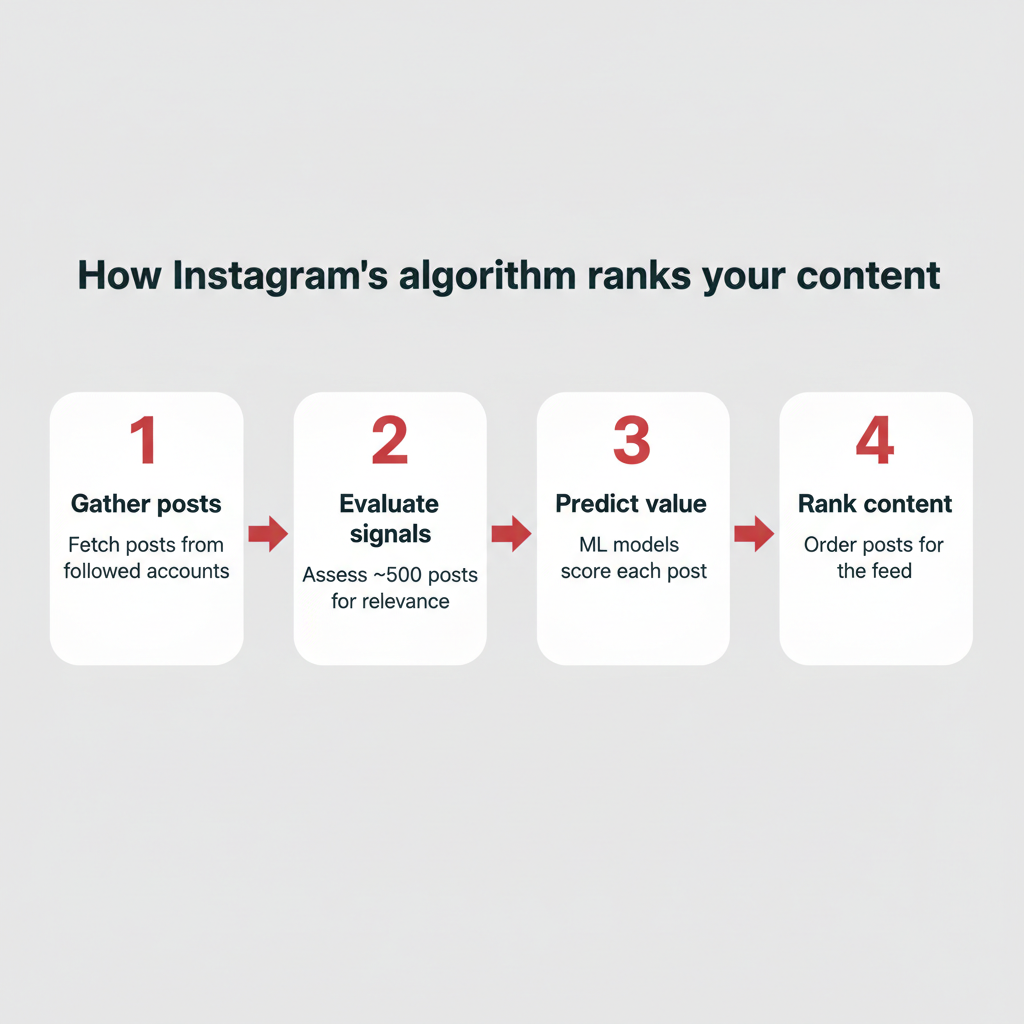
The Instagram algorithm analyzes content in four stages:
- Gather posts: Instagram fetches all available posts from followed accounts, filtering out posts that violate the Community Guidelines.
- Evaluate ranking signals: Evaluates a selection of approximately 500 posts to determine relevance to the user.
- Predict value: Various machine learning models make predictions about which posts are the most valuable to each user.
- Rank content: Based on ranking signals and the AI models’ predictions, the 500 posts are scored and ranked to determine which order they show up in a user’s feed.
Instagram feed algorithm
- How likely a user is to click to comment, based on past commenting activity.
- How long a user will spend scrolling Reels after clicking into one. Predicted by how often a user has entered the Reels feed, how many times they watched a video with sound over the last seven days, as well as time spent with the post author’s content over the past 84 days.
- How likely a user will spend scrolling the main feed after viewing the first post. Ranking signals include device platform and how many times a user views posts that are either 1-3 days old, 8-14 days old, or 14-21 days old.
- How likely a user is to scroll to the next post. Based on previous scrolling history, as well as how other users behaved after viewing that specific post.
- How likely a user is to spend more than 10 seconds on the first post. Influenced by time spent with the post author’s content in the past, device platform, and previous view history.
Instagram Stories algorithm
The most important ranking signals for the Instagram Stories algorithm are:
- How likely a user is to tap on a Story at the top of their home feed. Influenced by how often a user views Stories from a particular author and number of unseen Stories.
- How likely a user is to engage with a Story. Based on previous interaction history (likes, comments, replies) including the Story author’s content.
- How likely it is that the user is a family member or close friend of the Story’s author.
- How likely it is a user will swipe to the next Story or exit. Predicted by previous actions on Stories from that author and general Stories usage.
Instagram Reels algorithm
The most important Instagram Reels algorithm ranking signals are:
- How likely a user is to use the audio from the current Reel in their own. Signals include how long the user has been browsing Reels, how many times they’ve clicked on the audio link on Reels before, and used it.
- How likely a user is to watch more of a Reel than 95% of other viewers. Uses Reels of similar length to predict.
- How likely a user is to watch a Reel for less than three seconds. Influenced by how many other users watched less than three seconds.
- How likely a user is to comment or share the Reel. Predicted by previous user behavior.
Instagram Explore algorithm
The most important ranking signals for the Instagram Explore algorithm are:
- How likely a user is to follow an account from the Explore page. Predicted by time spent on content from that author and other accounts followed from Explore.
- How likely a user is to watch more than 95% of a video or spend more than five seconds on a post. Influenced by previous viewing history.
- How likely a user is to engage (comment, like, share, save). Signaled by previous engagement history and the overall view count of the post on the Explore page.
Of the thousands of signals that drive Facebook’s content ranking, these are some of the ones used most often, according to Meta:
- Facebook connections: Content chosen for users is largely from their friends, joined Groups, and liked Pages.
- Content format: If users watch videos, they’ll see more video content in their feed or photos if they view more photos.
- Likelihood of engagement: The algorithm predicts if a user will like, comment, share, or spend more time than usual on a post.
- Relevancy: A set of predictions about how aligned a post feels to a user.
X (Twitter)
The For You tab is a mix of content from followed accounts and recommended content, based on key ranking signals such as:
- Connections: Activity by accounts the user follows, including the accounts they follow and posts they have liked.
- Previous interactions: Previous likes, comments, and shares influence what the algorithm shows in For You.
- Relevancy: Posts relating to topics the user follows and trending topics in their location.
Known ranking signals for LinkedIn in 2026 include:
- Content quality: LinkedIn ranks content based on time users spend on posts, professional tone, total view count, and more.
- Spam filtering: Grammatical errors, tagging individuals you’re not connected to, or excessive hashtags can trip LinkedIn’s spam flags.
- Recent engagement: LinkedIn determines how valuable your post is to your network within the first hour.
- Relevancy: The people, pages, groups, hashtags, and topics a user follows influence the algorithm.
TikTok
Each user sees a unique For You Page (FYP) full of content ranked on these signals:
- User activity: Recent interactions, including liked, commented on, and favorited videos, accounts followed, and watch time.
- Video information: TikTok shows similar videos based on caption keywords, audio used, hashtags, and related topics.
- Account settings: Language, location, and device type influence a user’s For You page.
- Trends: Trends are big on TikTok, in large part due to trending audio.
YouTube
Important YouTube algorithm ranking signals include:
- Recent activity: Video recommendations are heavily influenced by those watched during the last session, search history, and previous likes.
- What users don’t watch: If YouTube suggests videos that the user never clicks on, the algorithm will stop recommending that type of content.
- Video performance: How many views and total engagement the video has already earned.
- YouTube SEO: Titles, thumbnail images, and descriptions factor into ranking, especially for search.
Key ranking factors when it comes to Pinterest search are:
- Visual relevance: The Pinterest algorithm is excellent at dissecting visuals and recommending similar Pins and products.
- Trends: Based on factors like user location, search history, and recent activity.
- Recent saves: What a user “pins” (saves) is very important.
Threads
Top Threads algorithm ranking signals include:
- How likely a user is to like, comment, or click on a post. Predicted by time spent on past posts and previous engagements.
- How likely a user is to visit a post author’s profile. Influenced by time spent on Threads and how many profiles the user previously tapped on.
- Time spent viewing posts. Threads tracks users’ average time spent on each post over the past 84 days.
Bluesky
Bluesky is committed to the idea of “algorithmic choice,” where users aren’t subjected to one algorithm, but free to create and curate multiple algorithms to match their interests.
To grow on Bluesky, brands should:
- Get involved with or create niche communities by making custom feeds for your industry or topic.
- Create a starter pack of employees and high-value posts.
Key Reddit algorithm ranking signals include:
- Upvotes and downvotes: Posts with a high ratio of upvotes to downvotes rise to the top.
- Comment volume and quality: Posts that generate active discussion threads tend to rank higher.
- Recency: Reddit’s “Hot” sort weighs recent posts more heavily.
- Subreddit relevance: Content is ranked within the context of each subreddit’s topic.
What changed in 2025-2026?
A significant shift has reshaped how algorithms operate over the past year.
- Bluesky has grown significantly, surpassing 40 million users.
How to optimize your content for social media algorithms in 2026
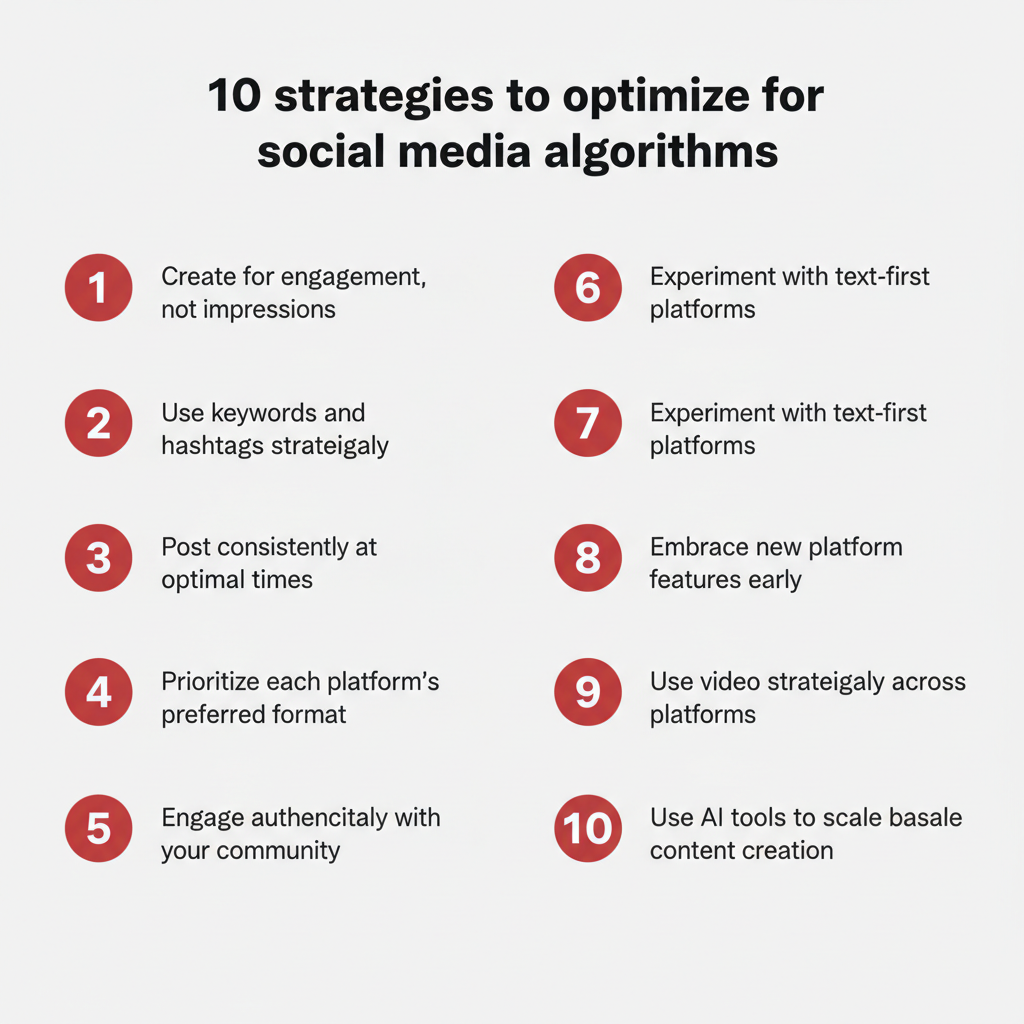
Understanding how algorithms work is only half the battle. Here are ten proven strategies to maximize your content’s reach across platforms.
- Create for engagement, not just impressions
- Use keywords and hashtags strategically
- Post consistently at optimal times
- Prioritize each platform’s preferred format
- Engage authentically with your community
- Experiment with text-first platforms
- Embrace new platform features early
- Use video strategically across platforms
- Measure and iterate based on analytics
- Use AI tools to scale content creation
1. Create for engagement, not just impressions
Every major algorithm rewards content that sparks interaction. Focus on creating posts that invite comments, shares, and saves rather than simply chasing views.
2. Use keywords and hashtags strategically
Social SEO is increasingly important as 46% of Gen Z only or primarily use social media for search instead of traditional search engines. Use relevant keywords in captions, alt text, and profile bios.
3. Post consistently at optimal times
Algorithms reward accounts that post regularly. A strong content planning cadence signals to algorithms that your account is active and worth distributing to followers.
4. Prioritize each platform’s preferred format
Algorithms tend to favor the content formats each platform is pushing. In 2026, that means Reels and carousels on Instagram, short-form video on TikTok, and text posts on LinkedIn and Threads.
5. Engage authentically with your community
Brands that invest in social media engagement — including leaving comments on others’ posts — will see more algorithmic promotion. Reply to comments on your own posts, too.
6. Experiment with text-first platforms
Threads, X, and Bluesky are all text-first environments where brands can refine their writing for social media and build discussion spaces.
7. Embrace new platform features early
Algorithms often prioritize newly launched features to drive adoption. Stay current with platform updates and be willing to test new features quickly.
8. Use video strategically across platforms
Video continues to dominate algorithmic feeds. Short-form video works well on TikTok and Instagram Reels, while YouTube rewards both long and short formats.
9. Measure and iterate based on analytics
Track key social media metrics to identify which content types, posting times, and formats earn the most reach and engagement.
10. Use AI tools to scale content creation
AI content creation tools help maintain a consistent publishing cadence while freeing up time for the strategic and creative work that algorithms reward most.
How does AI shape social media algorithms in 2026?
Artificial intelligence has become the backbone of modern social media algorithms. Here’s how AI is transforming content ranking in 2026.
- Hyper-personalized content ranking: Machine learning models analyze hundreds of behavioral signals in real time, from scroll speed to hover time.
- Content quality and moderation: AI-powered systems detect and demote low-quality or misleading content.
- Adapting to AI-generated content: Algorithms are evolving to prioritize authentic engagement signals over sheer volume.
- Predictive engagement modeling: Platforms use AI to predict not just whether a user will engage, but how they’ll engage.
What do social media algorithms mean for brands and content creators?
How do algorithms impact organic reach and engagement?
The organic reach your content earns is a direct result of how well it aligns with each platform’s algorithm. Reach drives everything else: no one can like, comment, or share unless they see the post first.
Why do consistency and content quality matter?
Consistency and content quality matter because algorithms reward accounts that demonstrate reliability and professionalism. Follow brand guidelines, use the right colors and logos, and post with a regular cadence, but leave room for experimentation.
Why is engagement everything?
Engagement is a major signal to social media algorithms that your content is worth promoting. What counts as a “good” level of engagement depends on how you measure it, and benchmarks vary across platforms and industries.
What do social media algorithms mean for users?
For users, social media algorithms determine what content appears in their feeds and shape their online experience. Social media algorithms are often blamed for shortening our attention spans, spreading misinformation, and causing negative mental health impacts in youth.
Without algorithms, our social media experiences would lack the quick access to like-minded communities that can foster positive discussions and connections with people around the world.
On the other hand, researchers have observed how social algorithms can trap users in an echo chamber where digital platforms intensify radical ideologies.
Frequently asked questions
What are social media algorithms?
How do social media algorithms decide what content to show?
Can you influence social media algorithms?
What is the most important ranking signal for social media algorithms?
How often do social media algorithms change?
Do social media algorithms favor video content?
How does AI affect social media algorithms?
What is the 30/30/30 rule for social media?
Are social media algorithms the same on every platform?
Save time managing your social media marketing strategy with Hootsuite. Publish and schedule posts, find relevant conversions, measure results, and more — all from one dashboard. Try it free today.
The post Social media algorithms in 2026: How 10 networks rank content appeared first on Social Media Marketing & Management Dashboard.