Key takeaways
- Social media governance is the system of policies, roles, workflows, and tools that control how your organization uses social media, and it is essential for managing risk at scale.
- A strong social media governance plan covers brand guidelines, security protocols, compliance requirements, crisis management procedures, AI use policies, and approval workflows.
- AI governance is now a critical component, covering everything from AI-generated content disclosure to responsible use of AI tools for social.
- The right platform centralizes governance across teams, brands, and regions so nothing falls through the cracks.
What is social media governance?
Social media governance is the system of policies, processes, roles, and tools that guides how your organization manages its presence on social media. It is the overarching structure that keeps every account, post, and reply aligned with your brand standards and legal obligations.
It helps to know how governance differs from two related terms. A social media policy is one document within your governance system that sets the rules for how people use social. Your social media strategy is your plan for what you want to achieve. Governance is the connective tissue that ties both together and makes sure they actually get followed.
Put simply, governance answers a bigger question than “what should we post.” It answers “who decides, who approves, who has access, and what happens when something goes wrong.” For a deeper look at the planning side, see our guide to building a social media strategy.
Why does social media governance matter in 2026?
Social media governance matters because scale multiplies risk, and 2026 has raised the stakes. AI tools now touch nearly every part of content creation, with AI-driven automation expected to double by 2028, regulators are tightening rules on disclosure and data privacy, and enterprise teams are spread across more platforms and regions than ever. A single ungoverned post can trigger a compliance violation, a security breach, or a reputational hit in minutes.
A strong social media governance plan turns that chaos into structure. Here is what good governance protects.
Protecting your brand reputation
A clear social media policy lays out exactly how your brand should show up online, from its voice to visuals, the whole package.
That clarity protects your brand in a couple of ways.
First, it makes your content feel unmistakably yours. People can recognize your posts as they scroll, trust that they are interacting with the right social media accounts, and easily spot which profiles actually belong to your brand.
Second, those guidelines keep your content aligned with your brand values. They give employees a clear understanding of how their own posts, whether on corporate or personal accounts, reflect back on the organization.
Managing regulatory and compliance risk
A strong governance plan strengthens your organization’s approach to social media risk management, especially around compliance, brand safety, and security.
Every organization has rules to follow on social media, from advertising standards to privacy laws to platform-specific policies. In 2026, that list keeps growing. AI disclosure requirements, evolving data privacy laws across regions, and new platform-specific rules all add layers your team has to track.
The consequences for getting it wrong can be serious. Financial penalties are common (the largest data privacy fine targeted Meta), and legal issues and reputational damage are just as impactful. In our post on HIPAA and social media, we note how even small missteps can lead to major fines. In regulated industries, sharing patient or customer information without consent is not just risky, it can be illegal.
A clear social media policy is your starting point, but governance builds a safety net around it. Clear approval workflows, defined decision-makers, and documented processes all add an extra layer of protection. You should also document requirements for response times and archiving, since these details matter during audits.
Reducing security threats
Security is another bucket of social media governance, and it is something every team needs to take seriously.
Let’s start with a simple rule: to anyone who is still sharing social passwords with team members, we beg you to stop. Build a clear password policy, grounded in documented security practices, into your governance plan and make sure someone is actually responsible for keeping it in place.
Tools like Hootsuite give you full password management control. You can manage access without ever sharing a password, and you can update or revoke access the moment someone changes roles or leaves the team.
The threat landscape has also evolved. Your governance plan should include ongoing training so your team is aware of the latest risks. AI-powered phishing, deepfake impersonation of executives, credential stuffing, romance scams, and fake accounts all show up more often than people realize, and they are harder to spot than ever.
Preparing for crises and staying agile
Decision-making can get messy, especially in larger organizations. A good social media governance plan removes that guesswork. It makes clear who owns which decisions and how those decisions should be made, which keeps your team flexible when social networks change constantly. New platform gaining attention? You have the process to decide whether it fits your brand. Algorithm change? You have the structure to respond fast.
That same clarity matters most in a crisis. Not every brand will have to deal with a full-blown reputational crisis (and hopefully yours never does), but no organization is completely immune. Sometimes the crisis is internal. Other times it is a larger global or regional event, or one fueled by online misinformation, that forces your brand to shift direction quickly.
Responding in those moments is never simple, but a strong governance plan takes a lot of the guesswork out of it. If your brand does end up in the spotlight for the wrong reason, your governance model, paired with real-time crisis detection, gives your team the framework to respond quickly, calmly, and thoughtfully.
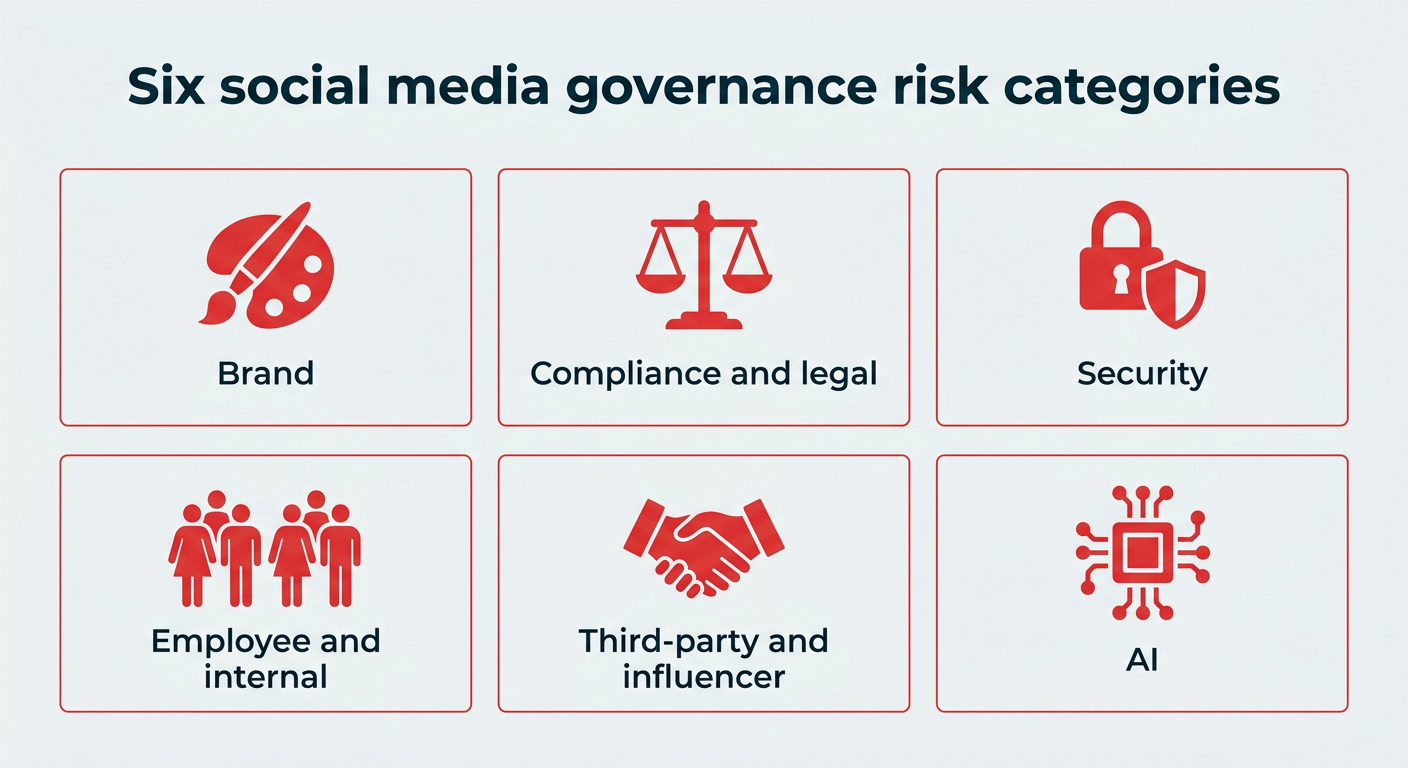
Key social media governance risks at a glance
| Risk category | What could go wrong | Governance safeguard |
|---|---|---|
| Brand | Off-brand posts, inconsistent voice, confused audiences | Brand guidelines and approval workflows |
| Compliance and legal | Missing disclosures, privacy violations, regulatory fines | Compliance requirements and documented processes |
| Security | Password theft, phishing, account takeover | Security protocols and role-based access |
| Employee and internal | Non-compliant personal posts, leaked confidential info | Clear social media policy and training |
| Third-party and influencer | Undisclosed sponsorships, off-brand partner behavior | Partner guidelines and contract standards |
| AI | Hallucinated content, brand voice drift, deepfakes | AI use policies and human review requirements |
AI and automation risk
AI is now the fastest-growing source of governance risk. AI-generated content can hallucinate facts, drift from your brand voice, or skip required disclosures. AI-powered threats like deepfakes and synthetic impersonation make it easier for bad actors to imitate your executives or brand. And when employees use ungoverned AI tools, sensitive data can leak into systems you do not control. This is exactly why AI governance is a must-have topic for any modern social media governance plan.
Influencer and third-party risk
Every partner you work with becomes an extension of your brand, and a potential source of exposure. Influencers can post undisclosed sponsorships, behave off-brand, or violate compliance rules on your behalf. Third-party apps with account access can leak data or post without authorization. Clear partner guidelines, contract standards, and regular access audits keep these relationships from becoming liabilities.
What should a social media governance plan include?
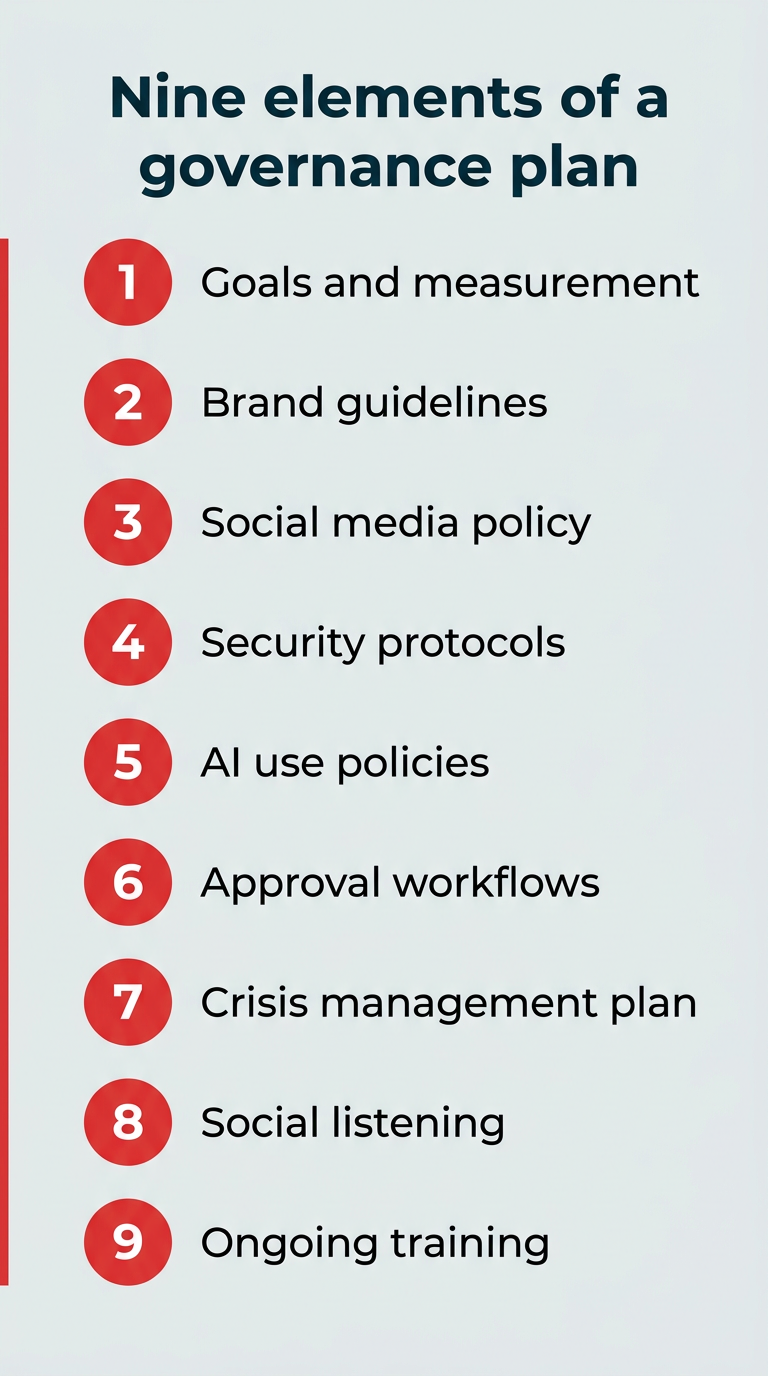
A complete social media governance plan covers the full lifecycle of how your brand shows up, from strategy to security. Here is a quick summary of the essential elements before we break each one down:
- Social media goals and measurement
- Brand guidelines and style standards
- A social media policy
- Security protocols
- AI use policies and responsible AI governance
- Approval workflows
- Crisis management plan
- Social listening and monitoring
- Ongoing training and education
Social media goals and measurement
Before you build the rest of your plan, get clear on purpose. Why are you using social media in the first place? In many ways, the answer guides all the other components of your governance plan.
Start by setting SMART social media goals and clearly defining what metrics you will use to measure your success. From there, outline how you will track, analyze, and report those results to the right stakeholders.
As you see what works and what does not, you can refine your goals and adjust your overall social media strategy. The insights you uncover here should loop back into your broader governance plan, including your brand guidelines.
Brand guidelines and style standards
Your brand guidelines are the anchor for everything you publish across your social media channels. They outline how you should sound, look, and show up online, which naturally protects your brand reputation.
But that’s just scratching the surface. Your brand guidelines should also clarify:
- Which platforms your brand is active on (and who manages each account)
- Expectations for accessibility and inclusive language
- Your approved visuals, colors, and graphic styles
- How to write handles, bios, and other profile details
- Standards for AI-generated content, including whether it must be labeled and which tools are approved for content creation
- Any compliance requirements your team needs to follow, like disclosures, contest rules, and so on
It’s also a good idea to link to your content library for examples of approved social content. This is a great place to keep templates too, so everyone can create consistent content without guessing.
A social media policy
A social media policy is your big-picture guide for how your brand uses social media. Starting from a structured policy template ensures you cover guidelines for employees both at work and on their personal accounts.
Your social media policy should include:
- What types of content you post on social, including off-limits subjects
- Privacy and confidentiality requirements
- Copyright and intellectual property guidelines
- AI content rules, including disclosure requirements, approved tools, and guardrails for what AI can and cannot draft
- Any compliance requirements, especially if you operate in regulated industries
- Employee guidelines on what is acceptable on both personal and professional accounts, including personal use of AI tools and sharing of AI-generated content
Feel unsure about defining how your employees can use their personal accounts? Remember that this isn’t about policing people. It’s about reducing risk.
Employees can accidentally create issues by sharing something non-compliant or by posting questionable content while identifying where they work. Even using unapproved apps on company devices can cause problems.
The goal isn’t to micro-manage people. This is more about education than dictatorship. Want to encourage your employees to share approved social content? Build an employee advocacy strategy into your social media policy.
Security protocols
Your security protocols protect your brand from risks like:
- Phishing, including AI-generated phishing at scale
- Malware
- Password theft and credential stuffing
- Scams
- Data breaches
- Deepfake impersonation of executives
- Fake accounts
- Hacking
Your security protocols should cover:
- Updates on new or emerging social media scams and AI-powered threats
- Requirement for two-factor authentication
- Social media activities to avoid for security reasons, like quizzes and third-party apps that ask for personal information
- How to create an effective password and when they should be updated
- Expectations for software and device updates
- Who to contact for social media security concerns
Tools like Hootsuite make this much easier to manage. Each team member gets their own login, with permissions you can adjust or revoke at any time, so passwords never need to be shared.
AI use policies and responsible AI governance
AI governance is the newest essential element of a modern social media governance plan. With 70% of CMOs lacking mature AI processes, and AI tools handling more of your content creation, listening, and customer care, you need clear rules for how they are used and who is accountable for the output.
A strong AI use policy should cover:
- Approved tools: Which AI tools your team can use for content creation, and which are off-limits
- Disclosure requirements: When and how AI-generated content must be labeled for your audience
- Human review: What level of human oversight is required before AI outputs go live, especially in regulated industries
- Data privacy: Rules for what data can and cannot be entered into AI tools
- Guardrails for automated actions: Limits on what AI can do without human sign-off, such as publishing or replying on your behalf
Good AI governance, powered by Wisdom, lets your team move fast without exposing the brand to hallucinated claims, compliance gaps, or off-brand content.
Approval workflows
Clear approval workflows don’t just help during a crisis, they can help you avoid one in the first place. A well-designed social media approval workflow makes sure the right eyes see every post before it goes live.
Your setup will depend on your industry and your level of compliance requirements. If you’re marketing outdoor adventure gear, for example, you might designate your social media manager to approve posts.
But if you operate in a regulated industry (financial services being a prime example), your compliance team may need to review every post, or at least anything new or high-risk. AI-assisted content often warrants an extra approval layer in these settings.
Hootsuite’s built-in approval workflows and team assignments ensure the right person is always working on the right task. Junior employees or even contractors and agencies can create your content. They then put it into the approval queue so it’s ready for signoff by more senior staff.
Crisis management plan
This, more than any other component of your social media governance documents, has the potential to protect your brand from critical damage and your team’s sanity when things get stressful. A clear crisis management plan is what keeps a bad moment from becoming a lasting one.
Your plan should spell out:
- How to identify a crisis and the degree of severity (e.g., negative publicity from a tasteless post is likely less severe than a major product recall for safety reasons, or a deepfake spreading misinformation about your brand).
- Roles and responsibilities for every department, including those beyond your social team
- A plan for internal communication
- When to pause scheduled content and what your publishing freeze looks like
- Who can write and approve crisis content
- Who is allowed to respond to crisis-related comments or media inquiries on social
Social listening and monitoring
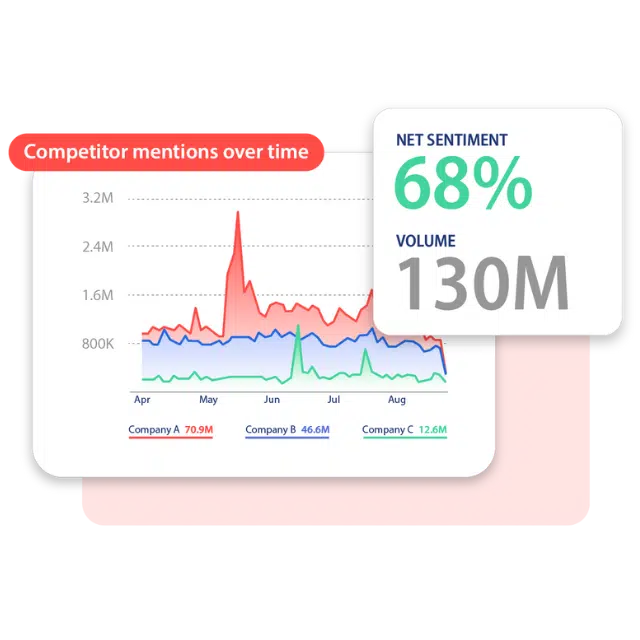
Social monitoring gives you a window into what’s being said about your brand on social media in real time. It shows you what’s working, what’s not, and what your competitors are up to.
It’s also one of your most important early-warning systems. It can alert you at the early stages of a social media crisis involving your brand. Tracking things like social sentiment and share of voice helps you spot potential issues before they snowball. If sentiment trends downward, or takes a steep dive, implement your crisis management plan.
Social listening takes all of this a step further. It turns what you’re monitoring into real-time intelligence you can actually use. Lumen, the integrated insights and listening app inside Hootsuite Social OS, surfaces these signals so the information can feed back into your brand guidelines, social media policy, and social media goals.
#1 Easy Social Listening
Brand mentions, trending topics, and sentiment at your fingertips. Enhance your social strategy with the insights that matter.
Ongoing training and education
Social media changes fast. The latest trend data alone shows major shifts in how brands use AI, listening, and content at scale. Ongoing training is important for employees at all levels within your social media team, and AI literacy is now part of the picture.
You may want team members to pursue social media certification, build AI literacy, or simply keep up to date on the latest changes in the social sphere. Either way, build a continuing education plan (and budget) into your social media governance documents.
We might be biased, but we think the courses offered through Hootsuite Academy are some of the best. The certification process ensures mastery of the relevant skills at a consistent level.
How do you build a social media governance framework?
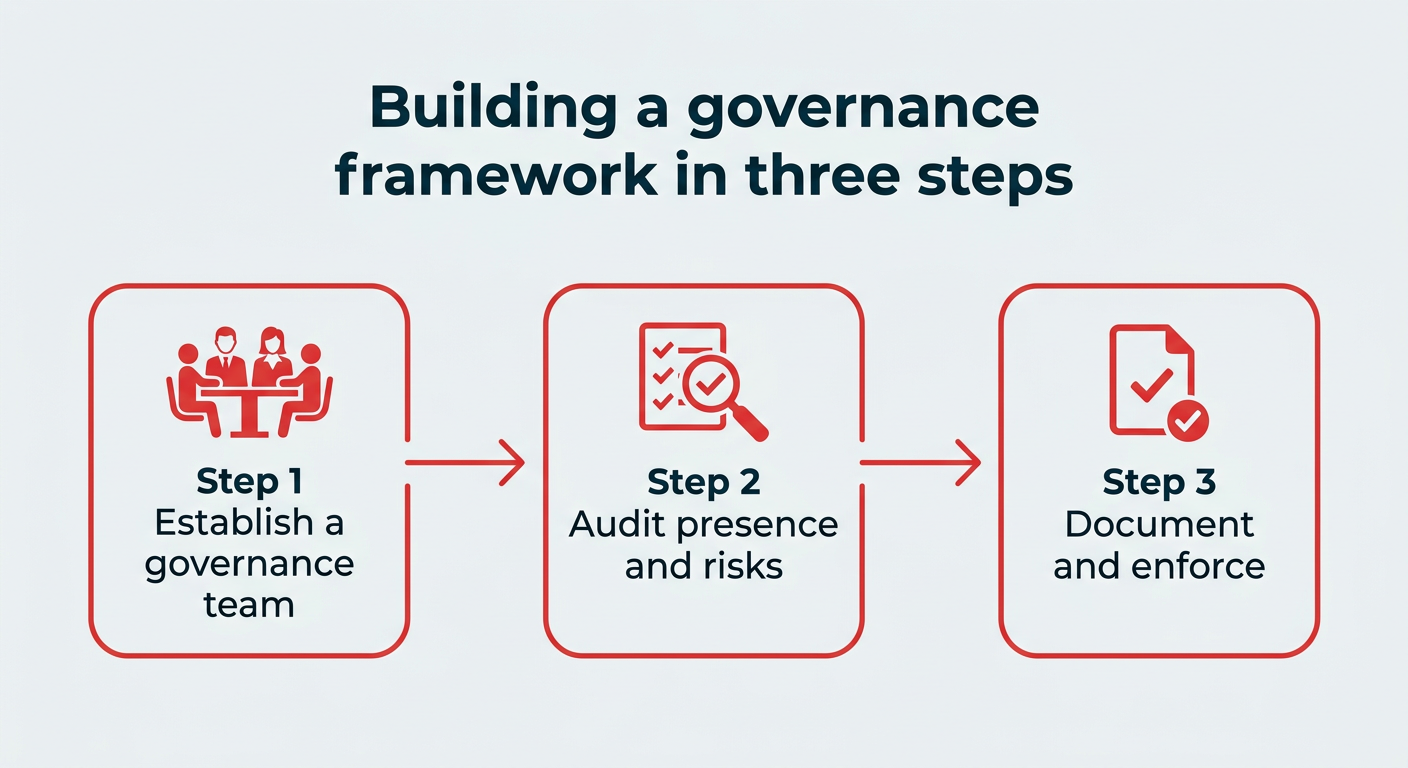
Building a social media governance framework is a process, not a one-time document. Here is a quick summary of the steps before we break them down:
- Establish a governance team or center of excellence
- Audit your current social presence and risks
- Document, distribute, and enforce your plan
Establish a governance team or center of excellence
Start by deciding who owns governance. The most effective approach is a cross-functional team, sometimes called a center of excellence, that pulls in marketing, legal, compliance, IT, and communications. Define clear roles: a governance lead who coordinates the whole system, platform owners responsible for individual accounts, and compliance reviewers who sign off on high-risk content. When ownership is clear, nothing falls into the gaps between departments.
Audit your current social presence and risks
Before you can govern, you need to know what you are working with. Take an inventory of every account, tool, and integration your organization uses, along with who has access to each. Review your existing policies against the elements above, including your platform’s compliance and data security standards, and flag the gaps. This audit almost always surfaces forgotten accounts, over-broad access, and outdated permissions that create risk right now.
Document, distribute, and enforce your plan
A governance framework only works if people actually follow it. Document your policies in one central, easy-to-find place, then distribute them to every stakeholder with clear expectations. Build enforcement into your daily workflows through approvals and role-based access rather than relying on good intentions. Finally, set a regular review cadence, at least quarterly, so your plan keeps pace with new platforms, regulations, and AI capabilities.
How does Hootsuite Social OS support social media governance?
Picking the right tools to execute your social media strategy is an important element of your social media governance plan.
We might be biased, but we believe Hootsuite Social OS is the best choice for enterprise social media management teams whose workflows prioritize efficiency, brand security, and powerful functionality. It brings governed workflows, connected systems, and AI-powered insights into one social operating system.
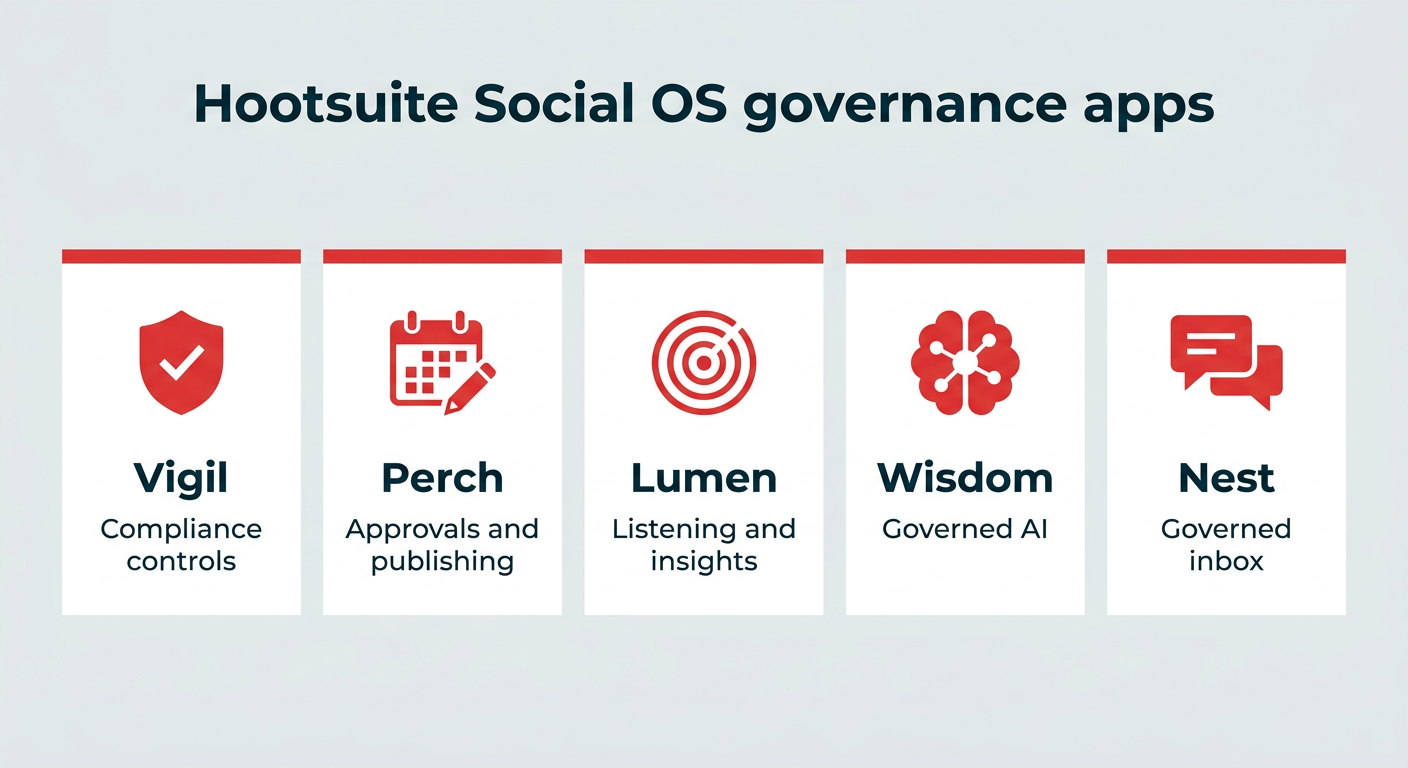
With Hootsuite Social OS, you can:
- Vigil: Keep content compliant and on-brand with governance controls built into your workflows
- Perch: Set approval workflows and publishing controls so the right person signs off on every post
- Lumen: Monitor mentions of your brand, track competitors, and turn listening into real-time intelligence
- Wisdom: Orchestrate AI across your social work with governance guardrails, not free rein
- Nest: Respond to customers, prospects, and followers from one governed inbox that collects interactions from all your channels
- Set custom access levels and permissions so your files and information stay secure, and easily pause scheduled posts during a crisis or unexpected pivot
FAQ: Social media governance
What is social media governance, and why do enterprises need it?
What is the difference between a social media policy and social media governance?
What is a social media governance framework?
How do global teams implement effective social media governance frameworks?
What should a social media governance policy include?
How does AI change social media governance requirements?
How do enterprises control access, approvals, and publishing rights?
Who should own social media governance in an organization?
How often should you update your social media governance plan?
How does Hootsuite support social media governance?
Save time managing your social media marketing strategy with Hootsuite. Publish and schedule posts, find relevant conversions, measure results, and more â all from one dashboard. Try it free today.
The post Social media governance: Build a 2026 plan to protect your brand appeared first on Social Media Marketing & Management Dashboard.