AI agents are coming for your to-do list.
Unlike chatbots that wait around for the next prompt, AI agents can work toward a goal, move autonomously through next steps, and keep things moving while you’re busy elsewhere.
We spoke with real social pros to see how they’re putting AI agents to work (and where they still keep a human at the wheel).
Key takeaways
- AI agents are different from chatbots. Chatbots respond to your prompts. Agents decide what needs to happen next, then act on it.
- AI agents can touch almost every part of social media work. They can help with strategy, content ideation, community management, reporting, and more.
- You set the guardrails. Decide what an agent can do alone, what needs your approval, and what stays fully human.
- Agents are useful for repetitive, ongoing work like weekly reporting, competitor monitoring, and flagging shifts in sentiment.
What is a social media AI agent?
A social media AI agent is software that can carry out social media tasks on your behalf. It makes decisions and takes action on its own, only checking in when it needs your help or approval.
The key word is action. Give an agent a goal, enough context, and access to the right tools, and it can work out what needs to happen next.
Say you ask an AI agent to find micro-influencers in your niche. Using your brand guidelines (and access to Google Sheets), it can research content creators, decide which ones are the best fit, and add them to a shortlist. A few months later, it can run the whole exercise again, right on schedule.
For marketers, that autonomy is the whole point. You give it a goal, and the agent works through the steps without any nudging.
Do it better with Hootsuite, the all-in-one social media tool. Stay on top of things, grow, and beat the competition.
How is an AI agent different from a chatbot?
The biggest difference is autonomy. Chatbots are reactive and prompt-driven. AI agents are proactive, deciding, acting, and learning as they work.
With a basic chatbot (like ChatGPT or Claude), you ask it a question, it gives you an answer, conversation over. It does exactly what you ask and not a step more.
An AI agent is different. It can take an objective, like “create a weekly Instagram performance report,” break it into steps, and work through them, usually with little to no human hand-holding.
Let’s take a closer look at the biggest differences between chatbots and AI agents:
| Chatbot | AI agent | |
| Autonomy | Waits for your prompt | Acts on its own toward a goal |
| Decision-making | Answers what you ask | Reasons through what to do next |
| Learning | Limited, its knowledge stops at its training data | Adjusts based on results and feedback |
| Task complexity | Best for simple, linear tasks | Best for complex, multi-step work |
How is an AI agent different from a scheduler?
A social media scheduler follows a publishing plan you set. It’s predictable: You ask it to publish a post every Tuesday at 10 a.m., and that’s exactly what it does. An AI agent, on the other hand, can decide what to post and when, then acts on those decisions.
That said, the line between scheduler and AI is starting to blur.
Take Perch by Hootsuite. Perch handles the familiar scheduling stuff — planning, approvals, and publishing — but it also works with Wisdom, Hootsuite’s social-first AI agent.
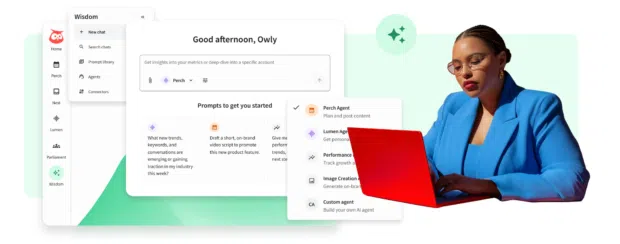
Ask Wisdom a question in plain language and it can pull relevant answers from your social data, content calendar, inbox, and listening dashboard. From there, it helps you act on what it finds, like drafting a post around what’s trending right now.
So instead of just putting content on a calendar, Wisdom helps you figure out what deserves your attention in the first place, and gives you a head start on what to do next.
What can a social media AI agent actually do?
AI agents can pitch in across almost every corner of social, from strategy and content creation to listening, influencer marketing, community management, and reporting.
The common thread is that they can take on multi-step work that would otherwise eat up a lot of manual time. Here’s where that comes in handy:
Strategy & planning
An AI agent can handle a lot of prep work behind your social media marketing strategy. For example, point it at your audience data and ask it to suggest content pillars. Or, have it draft a posting strategy for a new platform.
Agents can also keep your strategy from going stale. They can monitor changes in audience behavior or benchmark your social presence against competitors, then use those learnings to keep your strategy fresh.
Content ideation and creation
A good content idea starts with something catching your eye. A trend taking off. A competitor trying something new. A question your audience keeps asking.
AI agents can keep tabs on all of the above, then surface them before they become yesterday’s news.
That’s how Carson Celio, Content Strategist at O&G Public Relations, uses them. Every couple of weeks, Celio has an agent gather trend research, basically anything she may have missed from her daily scroll.
“It gives me a solid foundation to build from,” Celio says. “I think of it as my brainstorming buddy that helps me take those ideas, make them my own, and shape them to feel authentic to each client’s voice.”
Social listening and trend detection
Social listening can tell you a lot. Okay, sometimes too much.
An AI agent can help cut through the noise by flagging sudden sentiment shifts, spotting topics that are gaining traction, and surfacing conversations your brand should probably know about.
Anne-Marie Green, Head of Marketing at KnowRoaming, takes it a step further by having her agents turn that raw data into a daily briefing.
“We use our AI agents for social listening and finding the latest trends. They take the data and generate a daily report for us, with a detailed explanation of why these specific trends and topics are trending,” she shares.

Influencer marketing
Influencer marketing gets complicated fast. Once creators are onboarded, there are posts to track, links to manage, and performance numbers to monitor.
An AI agent can tackle those tasks individually, or, more impressively, wire them together.
Just ask Melina Giorgalletou, Content & Social Media Manager at Supernormal, who uses an AI agent to power a live dashboard for her creator program.
“It pulls view and engagement data across the ~950 videos from our creators, updates the dashboard, and generates tracked links in every post, helping us tie content back to sign-ups,” she shares.
Competitive intelligence
Keeping tabs on competitors is important, but it’s usually the first thing to fall off your list. An AI agent can keep tabs for you.
For example, it might flag:
- Whether a competitor post is getting unusually high engagement
- Whether a competitor is testing a new content format or channel
- Which topics keep showing up in your niche
Then, set it to check in weekly or monthly so you’re always in the loop.
Community management
An AI agent can act as a first line of support for routine customer messages and DMs.
Shawn Hill, VP of Growth at moveBuddha, relies on agents for exactly that: “They answer frequently asked questions or common inquiries, while redirecting the more complicated ones to the relevant department.”
For Hill, the payoff is simple: “It ensures everyone who reaches out gets a response in a timely manner.”
Analytics and reporting
Most analytics work is reactive: You pull a report, read it, and try to remember the takeaways for next time. An AI agent can take things one step further by spotting patterns and using them to shape what happens next.
For example, it may notice:
- Founder-led posts drive more comments
- Educational carousels get more saves
- Content about [insert topic] consistently underperforms
From there, it can feed those insights back into your strategy, whether that means more carousels, more thought leadership, or taking fewer swings at topics that just aren’t landing.

#1 Analytics Tool for Growth
Beautiful reports. Clear data. Actionable insights to help you grow faster.
How much control do you actually give up with an AI agent?
That depends on the task at hand. Ultimately, you decide how much freedom an agent gets based on the risk and complexity involved.
Think of it as three levels of control:
| Level of control | What it means | Example |
| Suggest | The AI agent recommends what to do, but doesn’t take action | It spots a spike in negative sentiment and flags it for your team |
| Act with approval | The AI agent does the work, but waits for your sign-off | It drafts responses to common DMs, but you approve them before they go out |
| Run autonomously | The AI agent runs the task on its own, within the guardrails you set | Every Monday, it pulls social performance data and sends your team a report |
Keep in mind that the right level of control can change from task to task. You might let an agent handle weekly reporting on its own, but require human approval before it responds to an unhappy customer.
A good rule of thumb: The higher the stakes, the more human oversight you’ll want.
What should stay human when you use an AI agent for social media?
The parts of social media that should stay human are the ones that rely on judgment, nuance, and real human connection.
We asked social media and marketing leaders where they draw the line. Here’s what they said:
Crisis management
Crisis management is all judgment. What do you say? What do you leave alone? When do you respond, and when is it smarter to stay quiet?
Hill says this is one area that should stay fully human.
“When there’s a PR issue or breaking news, these agents should be paused,” he says. “These delicate situations require human nuance and executive decision-making, something that they aren’t fully capable of.”
High-risk or public-facing work
The higher the stakes, the more important human review becomes. A first-draft caption is low-risk. A public statement or customer-facing response is not.
Green has a good gut check:
We ask a simple question: If our AI agents make a mistake on this specific task, what would the consequences be? Is it going to be a minor typo or a major crisis?
“If the final verdict is that the risk is minor, then it can take over, but if there is any reputational risk to the team or the overall brand, and there’s a chance it can impact customer or client trust, then we keep a human in the loop at all times,” she adds.
Brand voice and creative judgment
Canned AI copy might slide in a whitepaper. But on social, where content is supposed to feel current, conversational, and, well, human, it sticks out like a sore thumb.
That’s why, when it comes to brand voice and creativity, Celio is human all the way.
Social media professionals have an eye for design, storytelling and culture, and that’s something AI can’t replicate. I’m happy to devote extra time to that because it’s what keeps a client’s brand authentic and recognizable.
How does Hootsuite approach AI agents for social media?
Hootsuite is building AI agents directly into the social media workflow, so they can help teams get work done in one place. Here’s what that looks like:
Wisdom connects the dots across your social work
Ask Wisdom a question in plain language, and it can pull context from your content calendar, listening data, reporting, and more. But getting an answer is only half the point. Wisdom can help you act on what it finds.

Say it spots a conversation picking up steam in your listening data. You can ask what’s driving it, see how people are responding, then turn those insights into a first draft while the topic is still hot.

That’s what separates an AI agent from a standalone AI tool. Wisdom can move from insight to action across publishing, engagement, customer care, and reporting, without making you connect the dots yourself.
Build custom agents for specific tasks with Wisdom Studio
Some social tasks never really end. Competitor monitoring, trend research, and brand tracking all need constant attention.
Wisdom Studio is built for exactly that kind of ongoing work.
Give an agent its own instructions, starter prompts, and knowledge sources (think: brand guidelines, playbooks, whatever it needs). That gives it the context to handle a specific job without starting from zero every time.
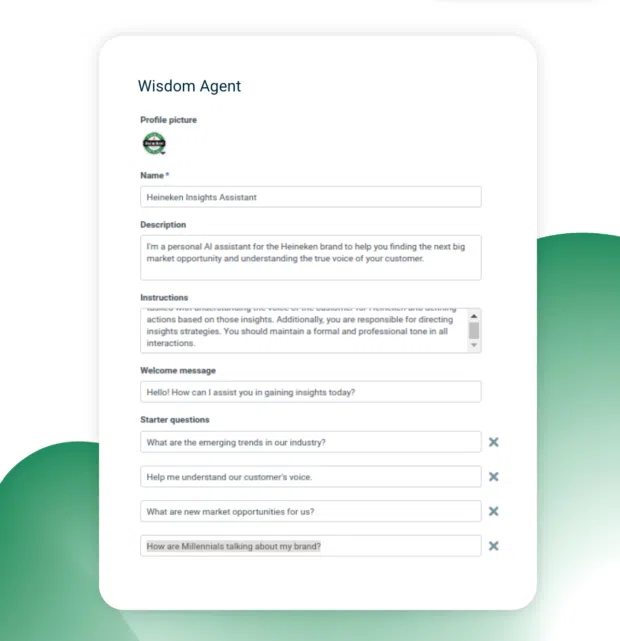
For example, one agent could monitor competitors and flag what’s changing. Another could watch for early signs of a potential crisis. The idea is to take the work that never ends and let it run quietly in the background.
Give Wisdom more context with MCP
The more context an AI agent has, the more useful it can be.
That’s where Hootsuite’s MCP connectors come in. They let Wisdom tap into the other tools your team already relies on — like your CRM or knowledge base — so it isn’t working from social data alone.

And it works both ways. Hootsuite can also connect to AI tools you already use, including ChatGPT, Claude, Gemini, and Copilot.
That means you could ask your AI assistant to draft and schedule posts with Perch, surface urgent customer messages from Nest, or dig into a sudden spike in brand sentiment with Lumen.
FAQ: Social media AI agents
What is a social media AI agent?
Is a social media AI agent the same as an AI chatbot?
What can a social media AI agent do?
Can an AI agent post to social media on its own?
Social media automation only makes sense for low-risk, repeatable work, like publishing pre-approved posts at optimal times. For anything high-stakes, like a sensitive announcement, it’s safer to keep a human in the loop.
Do AI agents for social media work for all platforms?
For example, Perch supports publishing across major networks including Facebook, Instagram, TikTok, X, LinkedIn, YouTube, and Pinterest.
Move faster on social with Hootsuite. Use Wisdom to spot trends, draft content, and help your team decide what to do next. Then use Perch to approve, schedule, publish, and track performance across your social channels. Try Hootsuite free today.
The post What is a social media AI agent? How they work + real examples appeared first on Social Media Marketing & Management Dashboard.